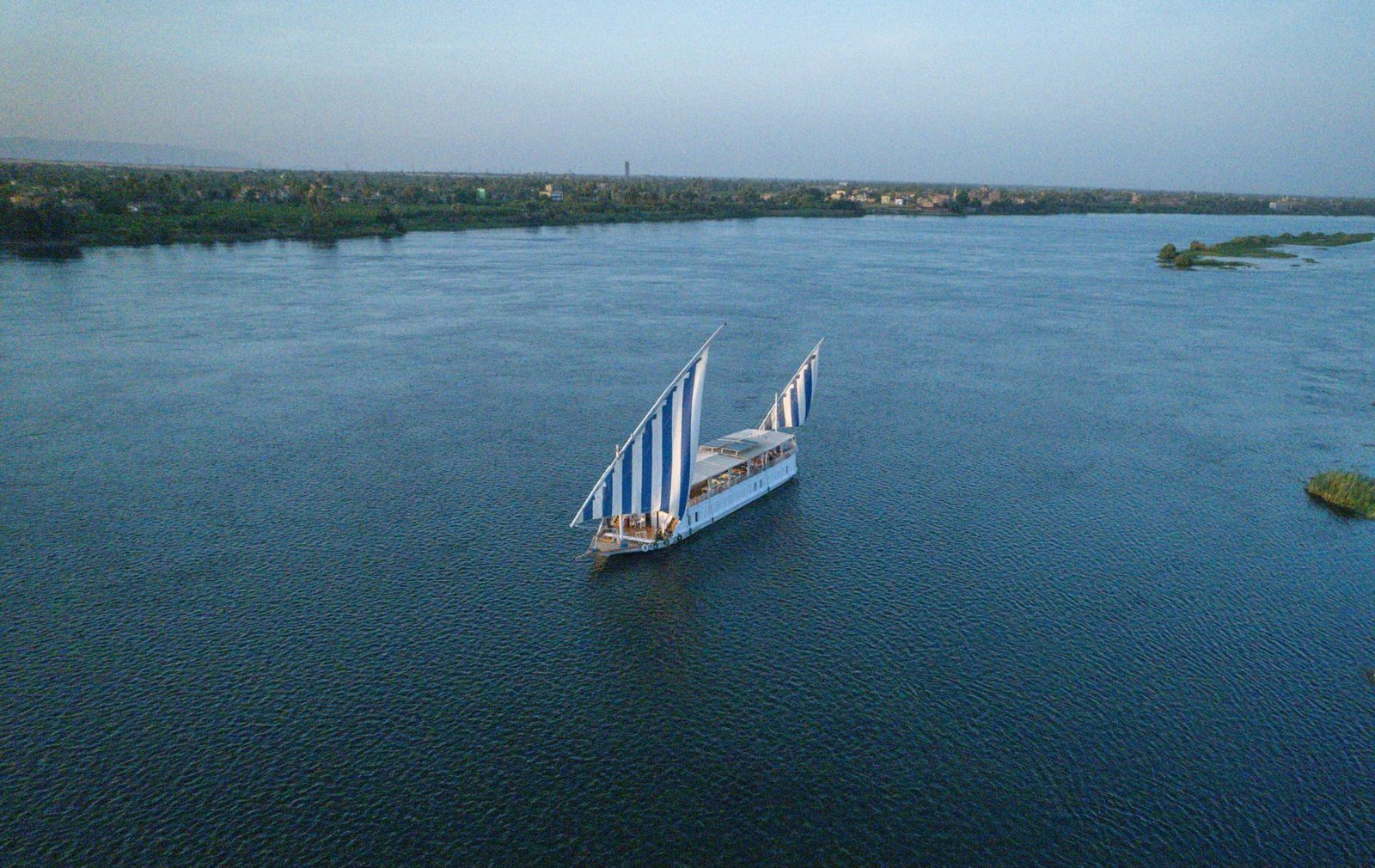
The word Dahabiya may be unfamiliar at first, but its history reveals much about the elegant sailing boats it describes.
Today the dahabiya is one of the most exclusive ways to experience the Nile. Combining history, privacy and boutique comfort, these graceful sailing boats offer a journey unlike the large cruise ships that dominate the river.
For travellers who want something more private and unhurried, Fleur Dahabiya offers a distinctive way to experience the Nile.
What Is a Dahabiya? The Quick Answer
A dahabiya is a small private sailing boat, a traditional wooden vessel built for cruising the Nile in Egypt without an onboard engine. Larger than a simple felucca yet much smaller than a conventional Nile cruise ship, it is designed for travellers who want privacy, quiet and a closer connection with the river.
Traditionally built of wood and fitted with tall sails, most dahabiyas have between 4 and 16 spacious cabins, so only a small number of guests are on board. That intimate size creates a boutique atmosphere where every journey feels personal rather than crowded.
Unlike the large floating hotels on the Luxor to Aswan route, a dahabiya moves slowly and quietly. It glides along the Nile at a leisurely pace, letting you see Egypt’s landscapes exactly as travellers did more than a century ago. When there is no wind it is towed by a small motorised launch that keeps engine noise and exhaust away from the boat entirely.
What is left is simply the sound of water, wind and sail. A pace of travel built for tranquillity rather than speed.
Today the dahabiya has become a premium, eco friendly, private charter boutique cruise, popular with travellers who want an authentic and unhurried way to discover Egypt’s history along the river that built it.
Where the Word Dahabiya Comes From
Literal meaning
The word is spelled ذهبية in Arabic, from the root word Dahab (ذهب), meaning gold.
Pronunciation
For non-Arabic speakers the phonetic pronunciation is dah-hah-BEE-yah.
Because the word is transliterated from Arabic you will find it spelled several ways across the web, all referring to the same vessel. Dahabiya is the spelling most widely recognised and used by cruise providers today, and it is the standard we use here.
When searching online you will see a variety of spellings, including:
- Dahabeya
- Dahabieh
- Dahabiyeh
- Dahabia
- Dahabeeyah
Historians generally associate the name with two traditional explanations.
The first suggests that early dahabiyas were owned by Egyptian rulers and wealthy families who decorated their boats with gilded woodwork, luxurious furnishings and golden details as symbols of prestige.
The second is more poetic. As these elegant boats sailed the Nile, especially at sunrise and sunset, their polished wooden hulls reflected the golden light and looked like floating golden vessels.
Both explanations capture what the dahabiya has always represented. Elegance, beauty and refined travel.
A Brief History: From Royal Vessels to Boutique Cruises
As European interest in Egypt grew during the nineteenth century, wealthy travellers adopted the dahabiya as the most luxurious way to explore the country.
Dahabiyas were designed as elegant floating residences where aristocrats, diplomats and members of the royal family could journey between Egypt’s great cities while enjoying comfort, privacy and spectacular scenery. The boats served not only as transport but as symbols of prestige, reflecting the owner’s social standing and taste.
The steamship revolution, and how the dahabiya survived it
Everything changed toward the end of the nineteenth century when Thomas Cook introduced steam powered ships to the Nile. These vessels cut travel times dramatically and made river cruises far more accessible.
But the dahabiya did not disappear. It became the choice of travellers who wanted what steamships could not offer. Privacy, slowness and intimacy. That is a position it still holds today.
The Modern Dahabiya Experience
A dahabiya cruise today combines traditional sailing with modern comfort, cultural experiences and plenty of time to simply be on the Nile.
- Full board accommodation, with the option of booking the entire boat privately for your own group and no minimum passenger count
- Village visits offering a genuine look at Egyptian countryside life: baking bread, kneading dough, walking through the fields and tasting traditional food
- Swimming stops directly in the Nile
- Larger cabins than you would usually find on a boat of this size, because dahabiyas are designed to sail even when some rooms are unbooked, putting comfort ahead of occupancy
- Seasonal operation, as most dahabiyas run primarily in the winter season rather than year round
If you are planning a trip, our guide on what to pack for a dahabiya Nile cruise covers the clothing, footwear and essentials you will want on board and during excursions.
The Anatomy of a Dahabiya
A traditional dahabiya combines classic Egyptian craftsmanship with modern comfort. Most vessels include:
- A handcrafted wooden hull
- One or two large lateen sails
- Between 4 and 16 spacious guest cabins
- Private en suite bathrooms
- An elegant indoor lounge or dining saloon
- A large open air sun deck
- An outdoor dining area
- Crew quarters
Modern dahabiyas also have air conditioning, WiFi on many vessels, good bedding and contemporary amenities, while keeping their traditional appearance.
What Makes a Dahabiya Different
- Smaller and more private
- A slower pace
- More flexible stops
- A greater connection with the Nile and the countryside
More Than Ancient Temples
A dahabiya journey offers far more than Egypt’s famous archaeological sites. Because of their smaller size, dahabiyas can stop at peaceful islands, quiet riverbanks and traditional villages that larger ships cannot reach. You can see where we stop on our Luxor to Aswan itinerary.
Depending on the itinerary, guests may enjoy:
- Walking through traditional Egyptian villages
- Visiting local farms and palm groves
- Watching freshly baked Egyptian bread being prepared
- Meeting local families
- Tasting authentic Egyptian cooking
- Swimming in carefully chosen stretches of the Nile
- Watching sunsets from secluded islands
These encounters give a deeper understanding of everyday Egyptian life beyond the monuments.
Why Choose a Dahabiya Over a Standard Nile Cruise
A dahabiya appeals to travellers who want to experience the Nile at a slower pace. Instead of focusing only on reaching the major monuments, the journey leaves time for the river itself, the landscapes, the smaller villages and the quiet moments between destinations.
For travellers who want more than a checklist of monuments, who want the quiet, the pace and the privacy that built Egypt’s original golden age of tourism, the dahabiya remains unmatched.
Is a Dahabiya Right for You?
A dahabiya suits travellers who value privacy, a slower pace and cultural experience over large ship entertainment and crowds.
It works well for couples wanting a romantic escape, families looking for a private holiday, groups of friends celebrating together, and anyone who prefers meaningful cultural experiences to crowded sightseeing.
Rather than simply visiting Egypt, a dahabiya lets you experience it at the pace the Nile has set for thousands of years.
Sail the Nile aboard Fleur
Seven cabins, fourteen guests at most, sailing between Luxor and Aswan from October through May.